You’ve probably heard the term “DSA” floating around in finance conversations lately. Maybe a friend mentioned it as a side income idea. Maybe you spotted it on a bank’s website or an NBFC brochure. Either way, if you’ve been wondering what DSA stands for and whether it’s a real opportunity, you’re reading the right article.
DSA stands for Direct Selling Agent, someone who acts as an authorised bridge between borrowers and banks or NBFCs. As India’s credit demand continues to grow at a double-digit pace, DSAs have become one of the most critical channel partners in the entire loan distribution ecosystem.
Whether you’re a salaried professional exploring a side income, a finance consultant wanting to grow revenue, or a first-time entrepreneur ready to enter the financial services space, understanding what DSA means in banking is your first and most important step.
Let’s break it all down.
DSA Full Form in Banking: What It Means and Why It Matters
The DSA full form in banking is Direct Selling Agent. It refers to a registered individual or business entity officially appointed by a bank or NBFC to source loan customers on their behalf.
A DSA is not a bank employee. They don’t sit behind a branch counter. They work independently on a performance-based commission model — which simply means the more loan cases they source and close, the more they earn. No fixed salary. No ceiling on income either.
The reason the DSA full form in banking is so widely searched today is straightforward: it represents one of India’s most accessible zero-investment business models open to anyone who is a salaried professional, self-employed, a student, an ex-banker, a loan agent, a financial advisor, a real estate agent, or an insurance agent.
DSA stands for Direct Selling Agent.
In banking, a DSA is an individual or entity registered with a bank or NBFC to source loan customers and assist them through the application process. The DSA earns a commission on every loan that gets successfully disbursed.
DSA Agent Meaning — Who Can Become One?
The DSA agent meaning goes beyond “someone who sells financial products.” A DSA is a formally registered representative of a financial institution, verified, assigned a unique DSA code, and authorised to legally source loan business.
There are different types of DSAs operating in India’s lending market today:
Types of DSA Agents in India
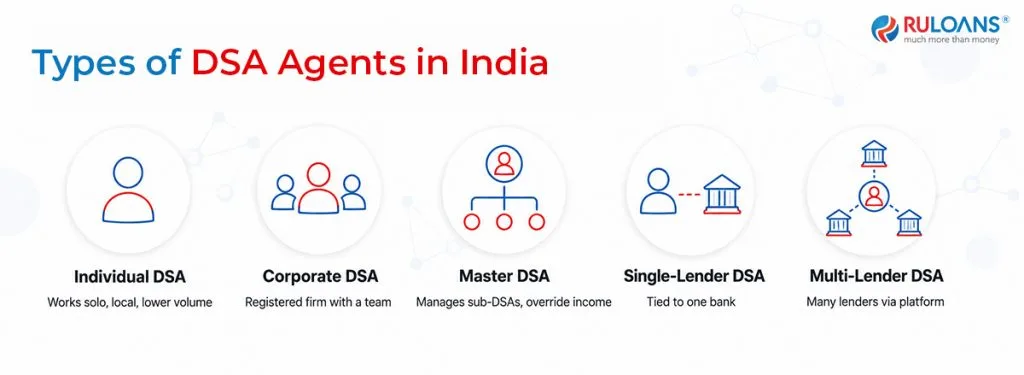
| Type | Description |
| Individual DSA | Works independently, typically local, lower volume |
| Corporate DSA | Registered company with a team, serves wider geographies |
| Master DSA | Manages a network of sub-DSAs, earns override commissions |
| Single-Lender DSA | Tied to one bank, gets dedicated training and products |
| Multi-Lender DSA | Partners with multiple banks/NBFCs via platforms like Ruloans |
Most high-performing agents eventually evolve into corporate DSAs or master DSAs, building teams, scaling systematically, and turning loan distribution into a full-fledged business.
Also Read: Types of loan DSA models and top DSA companies in India.
Basic Eligibility to Become a DSA:
- Indian citizen, minimum 25 years of age
- Valid PAN card and bank account
- Good credit history
- No specific degree required, product knowledge and a strong network matter more
DSA Agent Work and Responsibilities
One of the most common questions from aspiring agents is: what does a DSA actually do every day? The DSA agent work and responsibilities are more layered than most people expect.
- Customer Acquisition
This is where everything starts. DSAs build their pipeline through referrals, networking, social media, and community connections. Identifying people who need loans, whether it’s a business owner who needs working capital or a couple looking to buy their first home, is the foundation of the job.
- Product Consultation
Once a potential borrower is identified, the DSA explains the available loan options, compares lenders, and helps the customer understand interest rates, EMIs, tenure, and eligibility. This is where financial knowledge matters most.
- Documentation and Submission
A big part of the DSA’s day-to-day work involves collecting KYC documents, income proofs, bank statements, and form-filling. Getting this right speeds up the loan process significantly.
- Follow-Up and Coordination
After submission, the DSA stays in close contact with both the customer and the lender’s credit team. They resolve document queries, communicate updates, and ensure the loan moves to disbursement without unnecessary delays.
- Compliance and Ethics
DSAs must follow RBI-governed conduct norms. No misrepresentation of loan terms. No pressure selling. No document falsification. A DSA who builds trust in their community builds a sustainable business.
Also Read: How to register as a DSA loan agent online in 5 steps
| Do You Know? India’s personal loan market is one of the fastest-growing credit segments in the country. Between FY2023 and FY2024, personal loan outstanding balances grew by 25.6% year-on-year, while active loan accounts increased by 34.3%. The market was valued at around USD 29 billion in FY2024 and is projected to reach nearly USD 77 billion by FY2032, growing at a CAGR of 15.83%. Source: Markets and Data — India Personal Loan Market Report, 2025 |
DSA Income and Commission in India: How Much Can You Actually Earn?
This is the question everyone asks first, and understandably so. DSA income and commission in India are entirely performance-driven, with no fixed salary, but also no cap on what you can earn.
For every loan disbursed through a DSA’s referral, the bank or NBFC pays a commission equal to a pre-agreed percentage of the disbursed amount, which varies by loan product and lender.
DSA Commission Structure — Loan-Wise Breakup
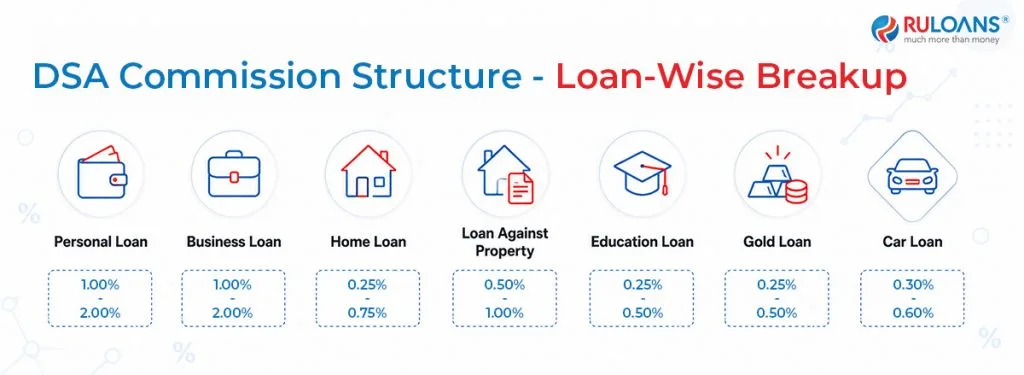
| Loan Type | Typical DSA Commission Range |
| Personal Loan | 1.00% – 2.00% of disbursed amount |
| Business Loan | 1.00% – 2.50% of disbursed amount |
| Home Loan | 0.25% – 0.75% of disbursed amount |
| Loan Against Property | 0.50% – 1.00% of disbursed amount |
| Education Loan | 0.25% – 0.50% of disbursed amount |
| Gold Loan | 0.25% – 0.50% of disbursed amount |
| Car Loan | 0.30% – 0.60% of disbursed amount |
Rates are indicative and vary by lender, loan amount, and DSA performance tier.
DSAs earn commission on successful loan disbursals. Personal loans and business loans often offer higher payouts than secured loans.
For example, if a DSA sources 5 personal loan cases of ₹5 lakh each in one month, total disbursement becomes ₹25 lakh. At 1.5% commission, earnings can be ₹37,500 for that month. With higher volumes or a mix of products, monthly income can grow beyond ₹1 lakh.
To understand how commissions grow as performance improves
Also read: Understanding DSA commission tiers and how payouts grow with performance.
DSA vs Bank Employee vs Loan Broker — Key Differences
A lot of people confuse these three roles. Here’s a clear comparison:
| Parameter | DSA Agent | Bank Employee | Loan Broker |
| Employment Type | Self-employed / Independent | Full-time salaried | Independent |
| Income Model | Commission-based | Fixed salary + incentives | Fee-based or commission |
| Products Available | Multiple banks & NBFCs | Only own bank’s products | Multiple lenders |
| Investment Required | Low to nil | Not applicable | Varies |
| Working Hours | Flexible | Fixed 9-to-5 | Flexible |
| Earning Ceiling | Unlimited | Capped by salary band | Moderate |
| Regulatory Oversight | Governed by lender + RBI norms | Bank HR + RBI | Less structured |
| Career Growth | Scalable to Master DSA / Corporate DSA | Grade-based promotions | Limited structure |
Also Read: DSA loan agent vs traditional loan officer — commission and working differences
Skills Required to Become a Successful DSA
You don’t need a banking degree to succeed as a DSA. But you do need the right combination of skills:
- Communication skills—To explain loan products clearly to customers
- Networking ability—Your pipeline is built on relationships
- Basic financial knowledge—Understanding credit scores, EMI calculations, and eligibility
- Follow-up discipline—Consistent tracking from lead to disbursement
- Digital fluency—Using Ruconnect Apps, portals, and CRMs efficiently
- Customer empathy—Understanding the borrower’s situation and guiding them appropriately
- Integrity and compliance—No misrepresentation, no document fraud
The best DSAs are not just salespeople; they are trusted financial advisors in their communities.
Benefits of Becoming a DSA Partner
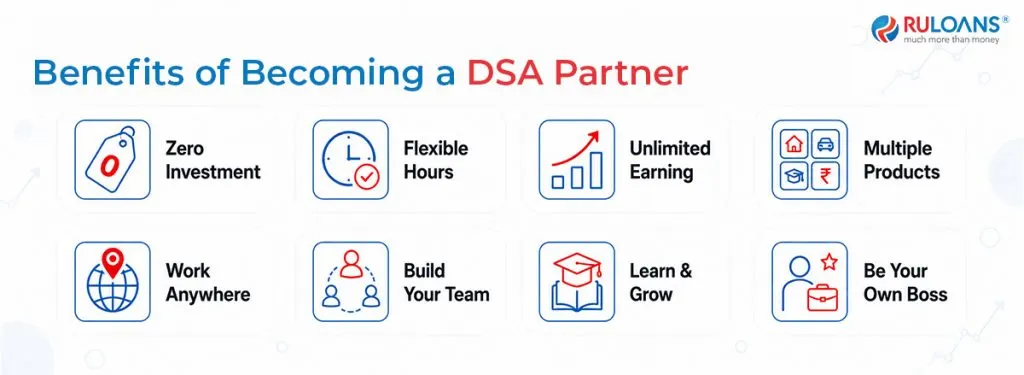
There’s a reason tens of thousands of professionals across India have chosen DSA as their business model. Here’s why it makes practical sense:
- Zero investment to start: No office setup, stock, or heavy capital needed.
- Flexible working hours: Work full-time, part-time, or alongside your current job.
- Unlimited earning potential: Higher performance can lead to higher income.
- Multiple products to offer: Earn through personal loans, home loans, business loans, and more.
- No location barrier: Source customers from different cities and markets.
- Growth opportunity: Build your own network or team as you expand.
- Professional learning: Gain knowledge of loans, credit, and financial products.
- Be your own boss: Run your loan business on your terms
Want to explore why DSA is considered the best business opportunity in India right now?
Also Read: Why Loan DSA is the best business opportunity in India 2025.
| Do You Know? The RBI issued the RBI (Digital Lending) Directions, 2025 on May 8, 2025 — consolidating all digital lending guidelines into one unified framework. It brings stronger compliance norms for lending intermediaries and greater transparency for borrowers, creating a more structured and credible environment for DSAs to operate in. Source: RBI Digital Lending Directions, 2025 |
Why Partner with Ruloans As a DSA Partner?
Choosing the right loan distribution platform makes an enormous difference to your income, growth, and day-to-day experience. Not all DSA partnerships are equal, and that difference shows up in your payouts, product range, and support system.
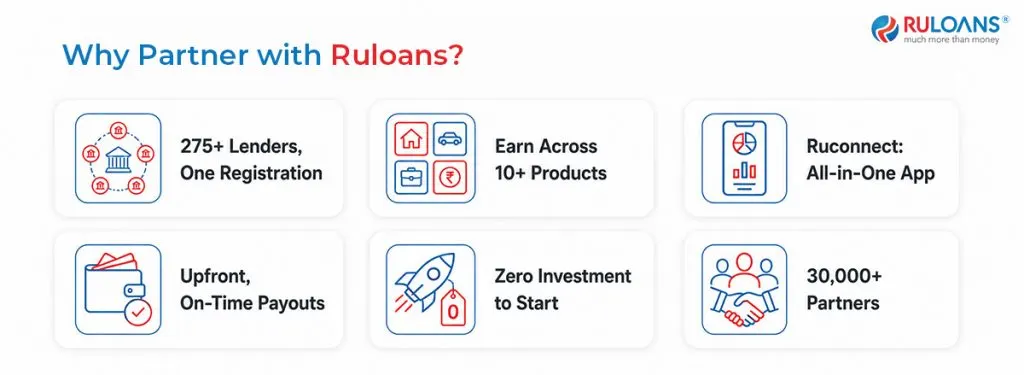
Ruloans is India’s No. 1 loan distribution company, and here’s what makes it the preferred choice for 30,000+ DSA partners across 4,000+ cities:
- 275+ Banking Partners: Access to the widest lender network in India, including top private banks, PSU banks, NBFCs, and HFCs
- All Financial Products: Personal loan, home loan, business loan, LAP, education loan, gold loans, car loans, machinery loans, solar panel loan, credit cards, insurance, and more
- Ruconnect App: India’s first B2B Loan Distribution Channel Partner App, with easy partner onboarding, real-time loan application tracking, login customer cases, loan eligibility checks, and claim payouts online
- Highest and On-Time Payouts: Competitive payout slabs, credited on schedule, with full transparency
- Dedicated Relationship Manager: Personalised support so you’re never figuring things out alone
- 25+ Years of Trust: ₹1,04,000 crore+ in loans disbursed across India
To see how Ruloans compares against other platforms
Also read: Top 10 loan DSA companies offering higher commission rates.
How to Start Your DSA Journey with Ruloans
Getting started is genuinely simple:
- Visit ruloans.com and go to the Become a Partner page
- Fill in your details: name, mobile number and email ID
- Submit KYC documents: Aadhaar, PAN, address proof, and bank account details
- Sign the DSA Agreement: formalise your Ruloans partnership
- Receive your DSA Code: Your unique ID to submit cases and track commissions
- Download the Ruconnect App: Start sourcing, submitting, tracking loan applications aand claim payouts online
- Earn your first commission: On every loan successfully disbursed through your referral
For a detailed walkthrough of the complete registration process and eligibility.
Also Read: DSA for loans — eligibility, commission, registration and income guide.
FAQs
Q1. What does DSA stand for in banking?
DSA stands for Direct Selling Agent. A DSA helps banks and NBFCs find loan customers and earns commission on successful loan disbursals.
Q2. What is the full form of DSA in finance?
The full form of DSA in finance is Direct Selling Agent. They act as channel partners who connect borrowers with lenders.
Q3. How does a DSA agent earn money?
A DSA agent earns through commission-based payouts. For every loan that gets disbursed through their referral, the DSA receives a percentage of the disbursed loan amount — typically ranging from 0.5% to 2.5% depending on the loan type and lender.
Q4. Is DSA business profitable in India?
Yes, DSA business can be highly profitable in India. A DSA sourcing even modest loan volumes can earn ₹30,000–₹1,00,000+ per month. Top-performing DSAs and Corporate DSAs earn significantly more with no upper income limit.
Q5. What is the difference between a DSA and a loan broker?
A DSA usually works through official lender partnerships and earns commission after disbursal. A loan broker may work independently with different models depending on market practice.
Q6. What documents are required for DSA registration?
Common documents include: Aadhaar card, PAN card, address proof (utility bill or rental agreement), last 6 months’ bank statement, passport-size photographs, and bank account details for commission credit.
Q7. Can a salaried person become a DSA agent?
Yes. Salaried individuals, self-employed professionals, business owners, or any other professionals can become DSAs, subject to eligibility and lender approval.
Q8. What is a DSA code, and why is it important?
A DSA code is a unique ID provided by a bank, NBFC, or platform to a registered DSA. It is used for login, case tracking, and commission processing.
Q9. How many banks can a DSA partner with at one time?
A DSA can partner with multiple banks and NBFCs simultaneously. This is one of the biggest advantages of working with a loan distribution platform like Ruloans, which offers tie-ups with 275+ lenders under a single partnership.
Q10. What is the minimum age to become a DSA in India?
The minimum age to register as a DSA in India is 25 years. Applicants must be Indian citizens with a valid PAN card and a good credit history.
Conclusion: DSA Is One of India’s Most Rewarding Finance Opportunities
DSA stands for Direct Selling Agent, and in India’s fast-growing credit market, it also stands for financial independence, flexible income, and a real opportunity to build a business without needing capital or prior experience.
India’s loan demand is rising across every category and every city tier. Banks and NBFCs are actively expanding their DSA networks to reach more borrowers. And you can be right in the middle of that growth, earning performance-based commissions with absolutely no ceiling.
Whether you’re starting fresh or scaling an existing finance practice, Ruloans gives you the lender network, technology, training, and support to build something meaningful.
Start your DSA journey today.
👉Become a DSA Partner with Ruloans — Free DSA Registration. support. Unlimited earning potential.

Every article on Ruloans is researched, written, and verified by a team of former bankers, certified financial planners, DSA industry veterans, and lending compliance specialists with over 25 years of hands-on experience in India’s loan distribution landscape. From decoding home loan eligibility and EMI planning for borrowers, to guiding DSA partners on commissions, registrations, and building a lending business — our content is grounded in real industry expertise, fact-checked against live RBI guidelines and current bank and NBFC policies, and built to help you make confident financial decisions.